
Table of Contents
- The Real Cause of Mould: Cold Walls, Not Dirty Air
- How Conventional Heating Makes the Problem Worse
- The Science Behind Wall-Surface Heating
- How Infrared Panels Raise Wall Surface Temperatures
- Infrared Heating and Irish Property Types
- What Wall-Surface Heating Cannot Do Alone
- A Practical Room-by-Room Guide
- Frequently Asked Questions
The Role of Wall Surface Heating
The Health Risks Are Serious
Ireland is one of the dampest countries in Europe. The health consequences of living in a mould-affected home are well-documented. The World Health Organisation’s Guidelines for Indoor Air Quality identify mould exposure as a driver of increased prevalence of respiratory symptoms, allergies, and asthma, as well as perturbation of the immune system. The WHO’s position is clear: the most important means of avoiding adverse health effects is prevention of persistent dampness and microbial growth on interior surfaces.
The Real Cause of Mould: Cold Walls, Not Dirty Air
Here is the physics that most homeowners and many tradespeople do not fully understand.
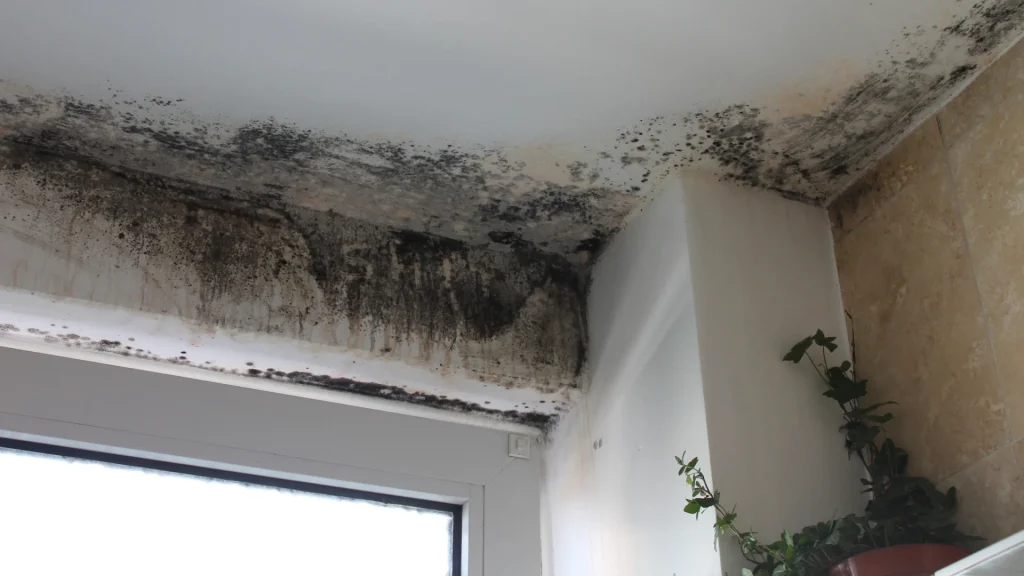
Mould on walls is almost never caused by dirty air. It is caused by condensation – warm, moisture-laden indoor air coming into contact with a wall or surface whose temperature has dropped below the dew point.
The dew point is the temperature at which air, at a given humidity level, can no longer hold its water vapour in suspension. When air contacts a surface colder than its dew point, that moisture precipitates out of the air and deposits as liquid water on the surface. In a typical Irish home in winter, with indoor relative humidity of 60–70% (easily achieved by cooking, bathing, drying clothes, and breathing), the dew point can be as high as 12–14°C. External walls in poorly insulated Irish homes can regularly fall to 8–10°C or lower during cold spells.
- Mould appears disproportionately in corners — where two cold surfaces meet, creating a cold bridge with restricted air circulation
- Mould appears on external walls — which are directly exposed to cold outdoor temperatures
- Mould appears behind furniture pushed against outside walls — where air circulation is blocked and wall temperatures are coldest
- Mould appears on window reveals and around single-glazed frames — which have the lowest surface temperatures in the room
- Mould appears near floor level in older homes — where solid floors conduct cold up from the ground
The solution in each of these cases is the same: raise the surface temperature of those cold surfaces above the dew point, and condensation stops. When condensation stops, mould cannot establish.
How Conventional Heating Makes the Problem Worse
This is counterintuitive, but important.
Conventional wet radiator systems – the standard gas or oil-fired central heating found in the majority of Irish homes – heat a room by convection. They warm the air, and warm air circulates through the space. This sounds logical, but it has a critical flaw in the context of mould prevention: heating the air increases the moisture-carrying capacity of that air without necessarily raising the temperature of cold wall surfaces.
In practical terms: a gas radiator placed on an internal wall warms the air in the centre of the room. That warmed air – now carrying more moisture – circulates toward the cold external walls. When it contacts those cold surfaces, it deposits moisture. You have heated the air and, in doing so, increased the amount of moisture available to condense on the coldest surfaces in the room.
This is why many Irish homeowners with full central heating systems still struggle with persistent mould on external walls, in corners, and in north-facing rooms. It is not a heating failure in the conventional sense. It is a fundamental limitation of convective heating in a cold-climate, high-humidity environment.
Intermittent heating makes this worse still. Many Irish households heat their homes for four to six hours a day – typically morning and evening. During the unheated hours, wall temperatures drop significantly. When heating resumes and warm air circulates, it encounters cold walls and deposits moisture. This cycle of warm-moist air meeting cold surfaces is one of the primary drivers of condensation in Irish homes.
The Science Behind Wall-Surface Heating
Infrared heating panels work on a fundamentally different principle.
Rather than heating air, infrared panels emit long-wave infrared radiation — electromagnetic energy in the 4–14 micron wavelength range (far infrared). This radiation is absorbed directly by the solid objects it encounters: walls, floors, ceilings, furniture, and people. The air itself is largely transparent to far infrared radiation and is warmed only secondarily, as the heated surfaces re-radiate energy into the space.
The result is a room where surface temperatures are elevated relative to air temperature, rather than the reverse.
In a room heated purely by convection, wall surface temperatures can lag significantly behind air temperatures, particularly on external walls. In a room heated by infrared panels, the walls, floor, and ceiling are themselves part of the thermal mass of the heating system — they are warmed directly, store heat, and release it slowly.
From the perspective of mould prevention, the critical mechanism is this: a wall that has been directly heated by infrared radiation will have a higher surface temperature than the same wall in a convectively-heated room. A warmer wall surface is less likely to fall below the dew point. Less condensation means less moisture. Less moisture means mould cannot establish.
Infrared Heating Ireland has been applying this principle in Irish homes and businesses since 2010, installing Ekosen Sunlife panels that emit far infrared in the optimal wavelength range for heating solid building materials. The observable effect — noted by homeowners and surveyors alike — is that north-facing rooms, external corners, and bathroom walls that previously exhibited persistent condensation show a marked reduction once infrared panels are the primary heat source.
How Infrared Panels Raise Wall Surface Temperatures
Let’s walk through the mechanism in concrete terms.
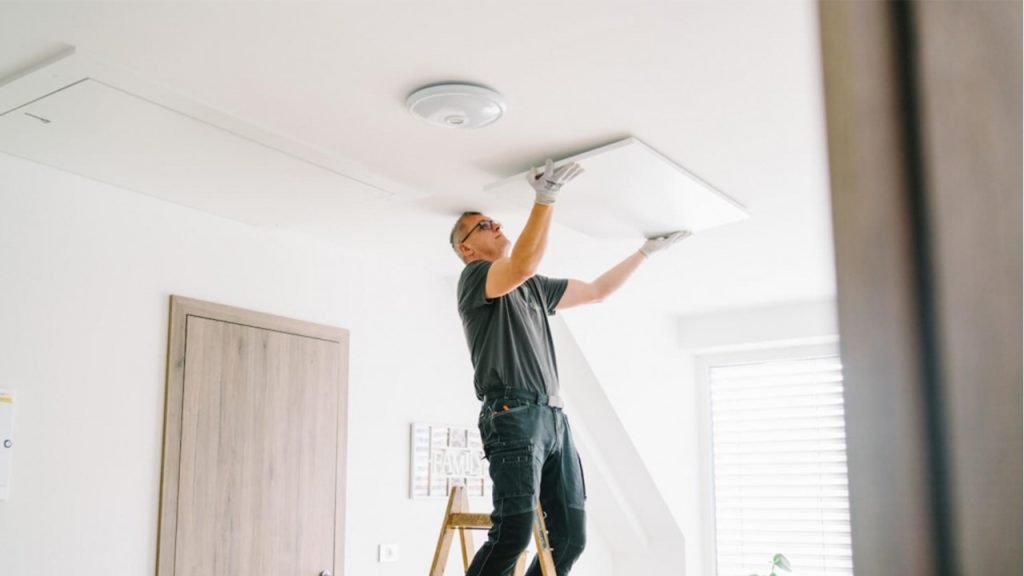
When an infrared panel is installed on a ceiling or wall, it emits radiation in a cone or spread pattern determined by its wattage and position. That radiation travels through air without heating it and is absorbed by the first solid surface it encounters. In the case of a ceiling-mounted panel, that means the floor receives direct radiation; the walls and furniture receive radiation reflected from the floor or emitted laterally.
The absorbed energy raises the surface temperature of those materials. A timber floor that might sit at 14°C in a convectively-heated room may reach 18–19°C with infrared heating. An external wall that might be at 10°C under convective heating may sit at 13–14°C when infrared panels are the primary source — enough, in many cases, to keep it consistently above the dew point of normal household air.
This is not a theoretical benefit. It is the reason infrared heating has been used in healthcare settings for decades — hospitals and clinical environments require precise control of surface temperatures to manage condensation, bacterial growth, and infection risk. The physics that makes infrared heating effective in a hospital ward is the same physics that makes it effective in a damp Irish bedroom.
Key factors that influence how much infrared heating raises wall surface temperatures in an Irish home:
- Panel wattage and room size — correct sizing is essential; an undersized panel will not deliver sufficient radiation to raise surface temperatures meaningfully
- Panel placement — ceiling-mounted panels provide the most even distribution of radiation across floor and wall surfaces
- Building fabric — a home with very low insulation values will lose surface heat faster; infrared heating is most effective when combined with at least basic insulation measures
- Run-time patterns — unlike gas heating, infrared panels are most effective when run at lower output for longer periods, maintaining consistent surface temperatures rather than heating air in bursts
Infrared Heating and Irish Property Types
Different types of Irish properties face different mould risks, and infrared heating addresses them in different ways.
Period Cottages and Pre-War Stone or Block Buildings
These properties typically have solid walls with no cavity, extremely poor insulation values, and cold thermal mass that takes a long time to warm up. Convective heating is particularly ineffective here because the air warms quickly but the walls — which are the thermal mass — remain cold for hours. Infrared heating is well-suited to these buildings because it targets the walls directly, warming the very surfaces most prone to condensation.
1960s–1980s Semi-Detached Estates
The backbone of Irish suburban housing, these properties often have partial cavity wall insulation (or none), single or early double glazing, and north-facing rear extensions that are perpetually cold and damp. The combination of air convection and intermittent heating creates persistent condensation patterns. Ceiling-mounted infrared panels in north-facing rooms and extensions offer a targeted solution.
Rural Farmhouses and Holiday Homes
Properties left unoccupied for periods face a particular mould challenge: the building fabric cools to ambient outdoor temperature, and when heating is resumed, the rapid introduction of warm air into a cold building creates intense condensation. Infrared panels connected to smart WiFi controllers — such as the IR SUN system used by Infrared Heating Ireland — can be set to maintain a low background surface temperature year-round, preventing the building fabric from dropping to cold enough temperatures to trigger condensation during vacancy.
New-Build A-Rated Homes
Well-insulated new builds have a different risk profile: they are often airtight, which means moisture generated by occupants (cooking, bathing, breathing) accumulates quickly. Here the issue is less cold walls than it is moisture management — ventilation, typically via MVHR, is the primary tool. Infrared heating complements this by maintaining even surface temperatures without the air movement that can carry moisture-laden air to cold spots.
What Wall-Surface Heating Cannot Do Alone
Honesty matters here. Infrared heating is a powerful tool for mould prevention, but it works best as part of a broader moisture management strategy. No single technology will eliminate mould in a severely damp or poorly maintained property.
Infrared heating will not:
- Fix structural damp caused by rising moisture from the ground (rising damp) or penetrating moisture from failed pointing, roof damage, or broken gutters — these are building defects requiring physical repair
- Replace adequate ventilation; moisture generated by cooking, showering, and drying clothes must be extracted at source, and trickle ventilation or extractor fans remain essential
- Compensate for extreme levels of thermal bridging in very poorly insulated homes without any insulation measures
What infrared heating does do is remove the primary driver of the most common type of mould problem in Irish homes — condensation on cold wall surfaces caused by the mismatch between indoor air temperature and surface temperature in convectively-heated buildings.
For the majority of Irish homeowners experiencing mould on external walls, in north-facing rooms, in corners, or around windows — the root cause is condensation, and wall-surface heating directly addresses it.
A Practical Room-by-Room Guide
Bedroom (particularly north-facing)
The problem: North-facing bedrooms are cold, generate moisture from breathing and sleeping (an adult produces approximately 0.5 litres of moisture per night), and are often poorly ventilated. Mould typically appears in the upper corners of external walls and behind wardrobes.
The infrared approach: A ceiling-mounted infrared panel sized at approximately 350–500W for a standard double bedroom (depending on insulation and BER rating) maintains even surface temperatures throughout the room. Avoid pushing furniture flat against external walls, and ensure trickle ventilation is not blocked.
Bathroom
The problem: Bathrooms generate large amounts of moisture in short bursts. Even with extractor fans, surfaces remain cool between uses, and moisture deposits on tiles, grout, and plasterboard.
The infrared approach: A mirror infrared panel (such as the Sunlife mirror panels available for Irish bathrooms) provides gentle background heat that keeps wall and ceiling surface temperatures elevated. This complements, not replaces, extractor fan use during and after showering.
Kitchen Extension / Rear Return
The problem: Single-storey rear extensions on Victorian and Edwardian terraces are among the most persistently damp spaces in Irish homes — cold roofs, limited insulation, and north-facing aspects combine badly.
The infrared approach: Ceiling-mounted panels in these spaces are particularly effective as they radiate heat down toward the floor and across the roof structure, warming the surfaces most prone to condensation.
Living Room (rarely used rooms)
The problem: A room that is only heated in the evenings will spend most of the day with cold wall surfaces. When heated air enters in the evening, condensation occurs on those cold surfaces.
The infrared approach: A smart WiFi-controlled panel set to maintain a low background temperature (say, 14–15°C equivalent surface temperature) throughout the day prevents the wall surfaces from dropping to dew-point-risk temperatures, without using significant energy.
Frequently Asked Questions
No. Infrared panels prevent mould by eliminating the condensation that allows it to establish and grow. Existing mould must be physically removed and treated with appropriate fungicidal products before infrared heating will be effective as a prevention measure. A professional remediation may be needed for significant infestations.
No. Infrared Heating Ireland provides complete system design for either full replacement or partial supplementary installations. Many Irish homeowners begin by installing infrared panels in the most problematic rooms — typically north-facing bedrooms or bathrooms — while retaining existing heating elsewhere.
Yes, and in some ways they are better suited to poorly insulated homes than heat pumps, which require a certain level of building fabric quality to perform efficiently. The wattage specification is adjusted for the building’s insulation level. Infrared Heating Ireland’s free heating design service calculates the correct panel sizes based on your property’s BER rating and construction type.
About Infrared Heating Ireland
Infrared Heating Ireland has been specialising in infrared heating solutions since 2010, with installations across more than 15,000 Irish homes and businesses. We supply premium Ekosen Sunlife infrared panels designed by European leaders in infrared heating technology, paired with our IR SUN smart WiFi controllers.
Our service includes free heating design consultation, system sizing based on your property’s BER rating and construction, and professional installation by trained electricians operating nationwide across Ireland.
If you are experiencing persistent damp or mould in your property and want to understand whether infrared heating is a suitable solution, contact our team for a no-obligation consultation.
Request a Free Heating Design & Quote
Nationwide: 0818 80 1000 | Dublin: 01 620 5300 | Cork: 021 601 0090
References and further reading: WHO Guidelines for Indoor Air Quality: Dampness and Mould (WHO, 2009); European Respiratory Society — The impact of poor housing and indoor air quality on respiratory health in children (2023); Central Statistics Office, Census of Population 2022 Profile 2 — Housing in Ireland; Research Gate — Age bands of Irish housing stock; Irish News — Housing Executive damp reports, March 2026.