
How heating surfaces instead of air can mean fewer airborne allergens, less dust, and easier breathing at home
If you’ve ever stood in front of a furnace vent and felt the air shift from cold to warm to slightly stuffy, you’ve encountered something most people never think to question: the way your heating system moves the air you breathe. Most homes rely on convection heating — forced-air furnaces, baseboard heaters, or radiators. These systems share the same basic mechanism, and that mechanism has a side effect that matters far more than most people realise, especially if you or someone in your household manages allergies, asthma, or chronic sinus issues.
Electric infrared heating works on a completely different principle. Instead of warming air directly, infrared heaters warm objects, surfaces, walls, and people — the same way sunlight warms your skin on a cold day before the air around you feels warm. That single difference in mechanism is why infrared heating has earned a growing reputation as a cleaner, more breathable way to heat a home.
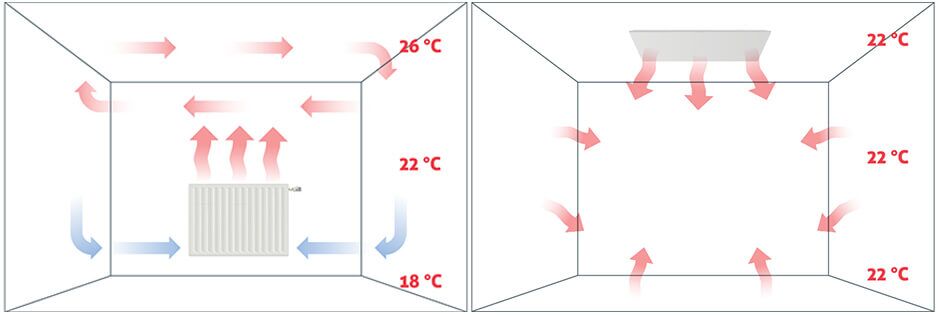
How Convection Heating Stirs Up the Air You Breathe
Convection heating works by warming air and circulating it through a room. Furnaces push heated air through ducts and vents, baseboard heaters create a thermal current as cool air is drawn in at the bottom and warm air rises out the top, and radiators work on a similar principle at smaller scale. In every case, the heating process depends entirely on air movement.
That movement doesn’t just carry heat. It carries everything suspended in the air or settled on nearby surfaces: dust, pet dander, pollen that has drifted indoors, dust mite waste, and mold spores. Convection systems with fans can redistribute these particles throughout a room, which makes them a significant concern for anyone with respiratory sensitivities. Even fan-free convection heaters generate enough thermal current to lift settled dust back into the air.
This is also why a furnace often produces that distinctive “heated dust” smell the first time it runs each season. Heating elements running hot enough scorch the dust and debris that has settled on them over the preceding months, releasing particles and odours directly into the airflow that reaches every room in the house.
Why Infrared Heating Is Often Described as “Cleaner”
Infrared heaters have no fan, no ductwork, and no reliance on moving air. Heat radiates directly from the panel to the objects, walls, floors, and people in the room. Those surfaces then warm the surrounding air gradually and passively — without the turbulence that convection systems create.
Because there’s no current pulling air across the floor and up toward the ceiling, dust and allergens that have settled stay settled. This is consistently identified as the central health-related distinction between infrared and convection heating: infrared heaters don’t stir up dust, pollen, pet dander, or other allergens the way fan-driven or convection heaters can. The air in a room with infrared heating stays calmer, meaning fewer airborne triggers circulating past your nose and lungs throughout the day.
This also explains a smaller but telling detail: the black soot marks that build up on walls and ceilings above traditional radiators and vents over time. Because infrared heating creates no airflow carrying dust particles toward a heat source, that buildup essentially doesn’t occur — and less of it ends up back in the air during your next cleaning.
A Better Environment for Allergies, Asthma, and Sinus Sensitivity
For people managing asthma or allergies, indoor air quality is often a bigger day-to-day factor than outdoor pollution. Reduced air circulation indoors is linked to lower respiratory irritation for people with asthma, allergies, or chronic lung conditions — simply because there is less repeated exposure to airborne triggers that would otherwise be continuously stirred up and reintroduced into the breathing zone.
A heating method that does not depend on moving air leaves fewer particles suspended for you to inhale. For a household with one family member who has asthma, or a child sensitive to dust and dander, that is a meaningful, practical difference you can notice within the first few weeks of switching.
What infrared heating is not: it is not a medical treatment, it will not cure asthma or allergies, and it is not a substitute for regular cleaning or an air purifier if you have significant allergen sensitivities. What it does is remove one ongoing source of particle circulation from your home environment — a meaningful piece of a broader air-quality strategy rather than a complete solution on its own.
The Humidity Connection: Dust Mites, Mold, and Dry Air
Air quality is not only about particles that are already airborne. Humidity plays a major role in two of the most common indoor allergens: dust mites and mold.
Dust mites thrive in relative humidity between roughly 55% and 80%, and struggle to survive once humidity drops below approximately 50%, since they absorb moisture directly from the air rather than drinking it. Mold has a similar relationship with moisture. The EPA recommends keeping indoor relative humidity below 60% — ideally between 30% and 50% — specifically to discourage both mold growth and dust mite populations.
Because infrared heating warms surfaces directly rather than heating air that then contends with cold walls and windows, it reduces condensation — the damp conditions that mold and mildew need to establish themselves. Damp and mould exposure is strongly linked to asthma attacks and chronic respiratory illness in the indoor air quality research literature, making this a genuinely significant benefit.
There’s a second humidity advantage worth noting. Convection systems — particularly forced-air furnaces — tend to noticeably dry out indoor air over a heating season, which is why many homes run a separate humidifier in winter. Infrared heating has a gentler effect on ambient humidity since it isn’t constantly pushing dry heated air through the space. This typically means less of the dry skin, sore throat, and irritated sinuses that commonly accompany a long winter with forced-air heating running around the clock.
How Infrared Heat Actually Feels
People who switch to infrared heating often describe the comfort itself as different — not just the air quality. Because infrared warms you and the surfaces around you directly, the heat feels steadier and more even, closer to standing in a patch of sunlight than sitting near a vent. There is no cycling blast of hot air followed by a cooling lull as a thermostat clicks on and off, and no draft from a fan.
Most infrared panel systems also run silently, with no blower noise and no mechanical vibration that might shake settled dust from nearby surfaces. That combination — a calmer, more stable indoor atmosphere with less particulate circulation — is the full picture behind why infrared heating is so often recommended for allergy- and asthma-prone households. It is less a single dramatic feature and more a set of small, compounding differences that add up to noticeably easier breathing across an entire heating season.

Frequently Asked Questions About Infrared Heating and Air Quality
Does infrared heating reduce dust in the air?
Yes. Because infrared heaters have no fan and do not rely on air movement to distribute heat, they do not stir up dust, pet dander, pollen, or other settled particles. This keeps significantly fewer allergens circulating in the air compared to fan-driven convection heaters.
Is infrared heating better for asthma sufferers?
Infrared heating is commonly recommended for asthma-prone households because it does not circulate airborne allergens the way forced-air or convection systems do. Reduced particle circulation means less repeated exposure to dust, dander, and mold spores — all common asthma triggers. It is not a medical treatment and does not replace advice from your doctor or respiratory specialist.
Does infrared heating cause dry air like a furnace?
No. Unlike forced-air furnaces, infrared heaters do not push large volumes of dry heated air through a space. Their effect on ambient humidity is gentler, which generally means less dry skin, fewer sore throats, and less nasal irritation over the course of a heating season.
Can infrared heating help with dust mites?
Infrared heating warms surfaces directly, which reduces condensation and helps keep indoor humidity lower. Since dust mites struggle to survive below approximately 50% relative humidity, the drier surface conditions created by infrared heating are less hospitable to dust mite populations.
What is the difference between infrared and convection heating?
Convection heating warms air and circulates it through a room, redistributing dust and allergens in the process. Infrared heating emits radiant energy that warms objects, surfaces, and people directly — the same mechanism by which sunlight warms your skin — without relying on air movement, resulting in calmer air with fewer airborne particles.
Does infrared heating help with mold?
Infrared heating warms walls and surfaces directly, reducing the cold spots where condensation forms. Since mold requires damp conditions to grow, warmer and drier surfaces are less likely to support mold or mildew compared to rooms heated primarily by convection.
The Bottom Line
Convection heating and infrared heating accomplish the same basic goal — a warm home — by fundamentally different means. One relies on moving air; the other relies on radiant energy absorbed directly by surfaces. That difference in mechanism has real consequences for indoor air quality:- Less air movement means less disturbed dust and fewer airborne allergens
- Warmer surfaces mean less condensation and a lower risk of mold
- A gentler effect on humidity means less of the dry, irritated feeling that convection heating can leave behind