
From hot yoga classes in Dublin to restorative Yin sessions in Galway, studio owners are finding that the quality of heat in their space matters more than they expected and that the solution isn’t a more powerful fan heater.
There’s a particular frustration familiar to anyone who runs a yoga studio in Ireland. You invest in beautiful flooring, thoughtful decor, quality mats. The space looks right. Then a class begins, and within twenty minutes someone near the back wall is cold, the ceiling feels stuffy, and the fan heater you installed is audible during Savasana.
It’s a heating problem, but not one that more heating solves. It’s a problem with how the heat is delivered.
Infrared panels work on a fundamentally different principle, and that difference turns out to matter enormously in a yoga environment. Studio owners who have made the switch tend to notice the difference immediately, not just in energy bills, but in how the room feels and how practitioners respond to it.
The core difference
Conventional heating warms air, which rises to the ceiling and escapes. Infrared panels emit radiant heat that warms surfaces and bodies directly, the floor, the walls, the practitioners themselves, regardless of where they are in the room. There is no fan noise, no moving air, no cold spots at floor level.
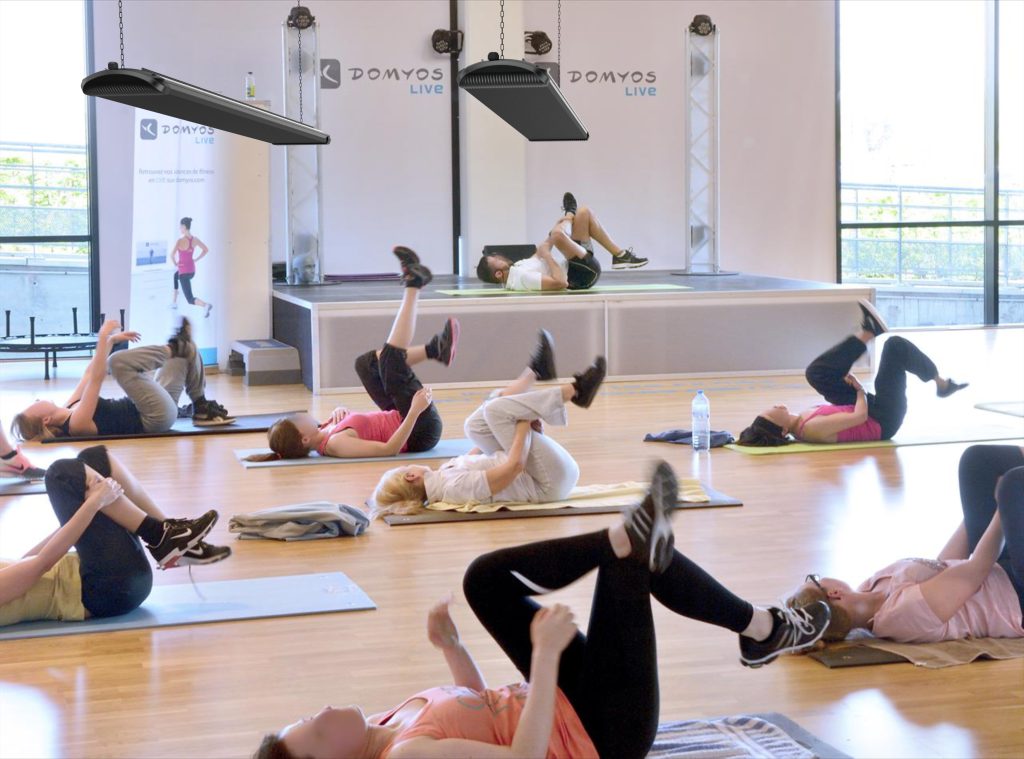
The problem with heating a yoga studio the conventional way
A yoga class makes unusual demands on a heating system. Practitioners move between standing poses and floor work. They hold static positions for extended periods. They lie still during Savasana, when the body temperature drops and sensitivity to cold is highest. And for hot yoga or Bikram practices, the room needs to reach and hold 35–42°C consistently across the entire floor area. Ducted air systems and fan heaters share a fundamental flaw: they heat air, and hot air rises. In a room with even a 2.8 or 3 metre ceiling, this creates a layered effect, warm near the top, cooler at mat level. The system works harder and harder to push more warm air into the space, but the floor where practitioners spend most of their time remains the coldest part of the room. Fan heaters add another problem: noise. The steady hum of a fan unit is easy to ignore in a gym or a classroom. In a yoga studio during a breathing sequence or a meditation hold, it’s a constant background intrusion that no amount of ambient music fully masks.What infrared heating actually does in a studio space
Infrared panels emit long-wave radiant heat, the same physics as sunlight, without any UV radiation. The heat travels in straight lines from the panel to whatever surface or body it reaches: the floor, the walls, a practitioner lying on a mat three metres below a ceiling-mounted panel.
Because the heat is absorbed directly by surfaces and bodies rather than warming the air in between, several things happen that don’t happen with conventional heating:
- The floor feels warm. Students in seated or reclined poses feel heat from below as the floor itself absorbs and re-radiates warmth — not just from above.
- Temperature is even floor to ceiling. There’s no stratification, no warm ceiling and cold floor. The room heats evenly because every surface is being heated.
- Humidity is preserved. Convection heating dries air aggressively as it circulates. Infrared leaves humidity largely undisturbed, which practitioners in hot yoga classes notice as a more breathable, sweat-appropriate environment.
- The room is silent. Infrared panels have no moving parts whatsoever. There is nothing to hear.
The panel that works for studio spaces: the HotTop
Standard flat IR panels are excellent for domestic rooms with ceiling heights of 2.4–2.7 metres. A yoga studio is a different environment: larger floor area, higher ceilings, no internal partitions, and in hot yoga cases a target temperature that domestic panels aren’t designed to sustain. The IR-panel HotTop is a longwave ceramic industrial infrared panel designed precisely for this kind of space. It reaches operating temperature in approximately 15 minutes, works effectively at ceiling heights up to 3 metres, and can be ceiling-mounted directly or suspended on adjustable cables from higher structures. For studios where ceiling mounting isn’t practical, it can also be wall-mounted and angled at 45° to radiate across and down into the practice area. The black textured faceplate isn’t just an aesthetic choice, the surface geometry improves heat radiation efficiency. The unit is IP55 rated, meaning it handles the higher humidity levels of a hot yoga environment without issue.Studio sizing
A typical 60–80m² studio with a 3-metre ceiling and reasonable insulation generally requires 4–6 HotTop panels depending on target temperature and window area. We provide free site measurements and panel layout designs for all studio enquiries, no obligation to proceed.
Scheduling heat around your class timetable
One of the practical advantages that studio owners mention most is the ability to match heating precisely to their schedule. A yoga studio doesn’t need to be at temperature at 7am if the first class starts at 9. It doesn’t need to stay warm between a 6pm and an 8pm session if there’s an hour gap.
The IR Sun WiFi controller connects to the panel system and allows you to programme a weekly schedule that follows your class timetable. The 15-minute warm-up time of the HotTop means panels can switch on at 8:45 for a 9am class and be fully up to temperature before the first students arrive. Between sessions, they drop to a standby level or switch off entirely.
For a busy studio running 6–8 classes across the day, the difference between heating a space continuously for 12 hours versus heating it for the actual session periods is significant. You’re not paying to heat an empty studio.
What the switch looks like in practice
Installation for a yoga studio typically takes a single day. Our team visits the space, takes measurements, produces a panel layout based on ceiling height and floor area, and installs. Most studios can run their regular class schedule the following morning.
Because infrared panels run on electricity with no gas supply, no pipework and no boiler, there’s no major building work involved. The panels are mounted to ceiling brackets or suspended from the ceiling structure and connected by your electrician. The full installation service is handled by our trained team from design through to commissioning.
There’s no ongoing maintenance. No annual boiler service, no filter cleaning, no compressor to replace after 10 years. The HotTop carries a 3-year warranty and is built for commercial durability in high-use environments.
Which yoga practices benefit most
The honest answer is that most yoga and movement practices benefit from infrared in some way, but the gain is most pronounced in:
Hot yoga and Bikram — where hitting and holding a high target temperature evenly across the floor is the primary challenge
Yin and restorative yoga — where students are on the floor for extended periods and sensitivity to cold at mat level is highest
Meditation and breathwork — where total silence during practice is not a preference but a requirement
Pilates and barre — floor-based, precise movement where draughts or noise from a fan unit are a distraction
For Vinyasa and Hatha classes, the gains are real but more subtle — practitioners notice a more even quality of warmth and the absence of air movement, without necessarily knowing why the room feels better than their previous studio.
Common questions from studio owners
Yes. The HotTop panel is a longwave ceramic industrial unit that reaches operating temperature in approximately 15 minutes and is designed to sustain the 35–42°C ambient temperatures required for hot yoga and Bikram practices. The number of panels required depends on floor area, ceiling height and insulation — we provide a free sizing assessment for studio enquiries
No — this is one of the key differences from convection heating. Fan heaters and ducted air systems circulate and heat air, which aggressively reduces humidity. Infrared heats surfaces and bodies directly without significantly affecting air humidity, resulting in a more comfortable, breathable environment. Hot yoga practitioners in particular notice the difference.
Yes. Infrared panels have no moving parts — no fans, no compressors, no pumps. The panel surface heats up and radiates warmth silently. There is nothing to hear during operation, which makes them suited to meditation-led practices where background noise is a genuine issue.
A typical yoga studio installation is completed in one day by our team. Most studios can run their regular timetable the following morning. Because there is no gas supply, pipework or major building work involved — panels are ceiling-mounted and electrically connected — the disruption is minimal.
Running costs depend on usage, tariff, and insulation. Infrared panels combined with smart scheduling — running only during class times with a 15-minute pre-warm — typically result in lower effective running costs than systems kept at temperature throughout the day. For studios pairing with solar PV, the running cost can be reduced further by using generated electricity during daytime classes.
Yes. The infrared emitted by heating panels is long-wave far infrared (FIR) — the same type of natural warmth as sunlight, with no UV radiation. It has been used in healthcare and physiotherapy environments for decades. There are no established health risks associated with far infrared panels at normal operating distances and temperatures.